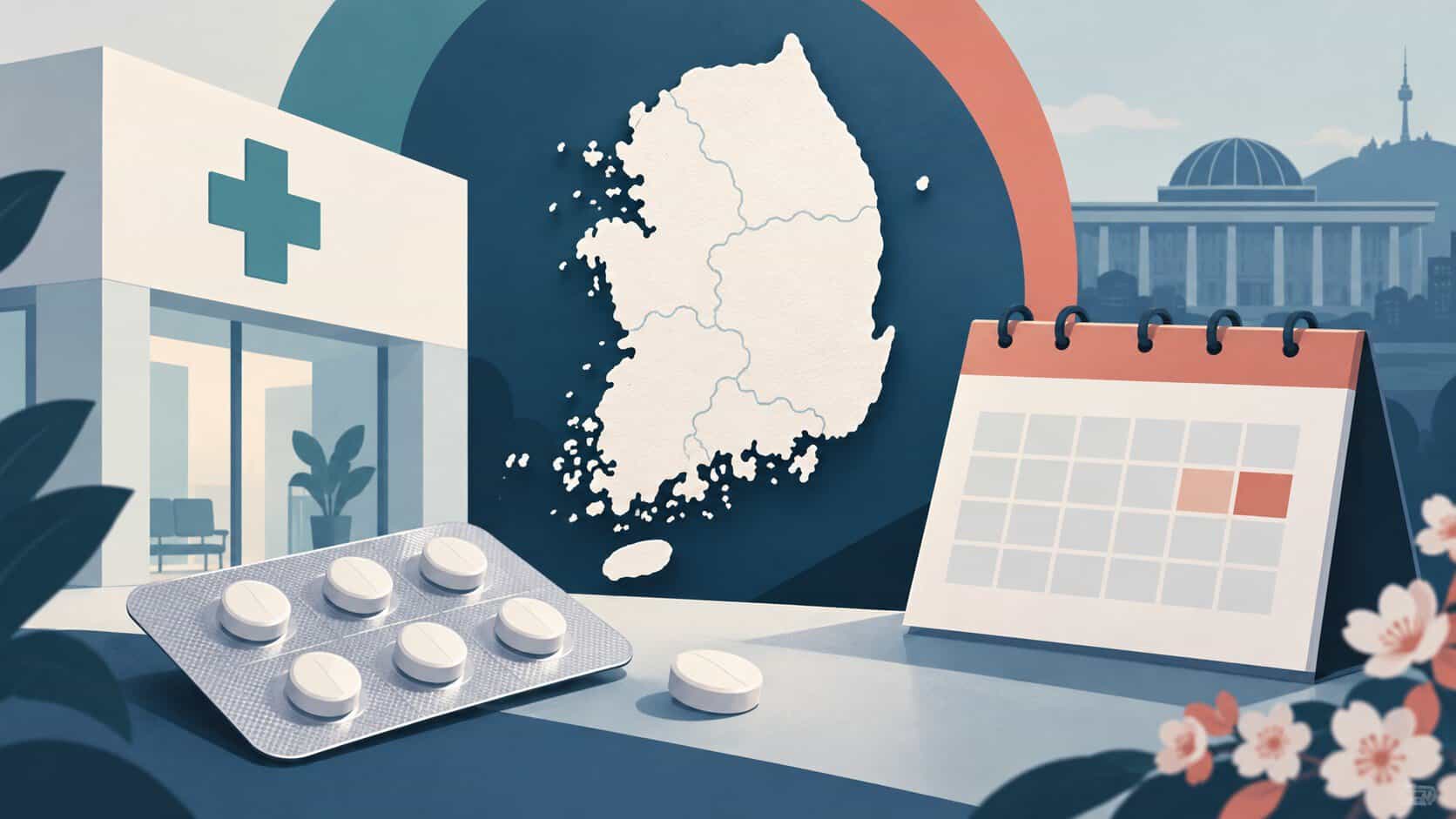
South Korea plans to introduce medication abortion for the first time, a policy shift that could finally close one of the biggest gaps left by the country’s 2019 Constitutional Court ruling on abortion.
The government said on September 16 that it aims to make a mifepristone-and-misoprostol combination available for pregnancies of up to nine weeks by the first quarter of 2027. For the first two years, doctors would both prescribe and dispense the medication at hospitals and clinics. The drug itself still needs regulatory approval, and lawmakers still have unfinished work on the broader legal framework.
That combination — a concrete rollout plan, but not an immediately available medicine — is why overseas readers may see seemingly contradictory headlines saying South Korea has “approved,” “will approve,” or “plans to allow” abortion pills. The clearest reading is this: the government has committed to a phased introduction, but the product is not yet available to patients.
There are no central criminal allegations in this story. The disagreements are mainly about health policy, reproductive rights, medical liability and how quickly South Korea should fill a legal vacuum that has lasted for years.
What exactly has South Korea announced?
Prime Minister Han Seong-sook announced a government plan to introduce medication abortion for pregnancies of up to nine weeks. The product under review is a combination pack containing mifepristone and misoprostol, two medicines commonly used together for medication abortion.
Under the plan, access would begin through medical institutions. For an initial two-year period, a doctor would prescribe the medicine and also dispense it directly rather than sending the patient to a pharmacy. Korean officials say the approach is intended to allow closer monitoring while clinical guidelines, adverse-event systems and other safeguards are developed.
After that initial period, the government says it could move toward the more familiar model in which a doctor writes a prescription and a pharmacy dispenses the medication, assuming the necessary safeguards are in place.
The target is the first quarter of 2027. That timetable, however, depends on regulatory review and implementation work.
Can people in South Korea get the abortion pill legally right now?
Not yet through the formal domestic system.
This is the most important practical point. The government’s announcement is a rollout plan, not proof that a patient can walk into a Korean clinic today and receive the medication.
The Ministry of Food and Drug Safety is still reviewing the relevant product application. Korean reporting identifies the product under review as Mifegymiso, a co-pack containing mifepristone and misoprostol.
The distinction matters because years of delay have pushed some people toward unauthorized online sellers. President Lee Jae Myung raised that problem in July, saying women were obtaining abortion medication from overseas channels without reliable medical supervision. The government now argues that bringing the medication into the regulated health system is a public-health measure as well as a reproductive-rights issue.
Readers should also be cautious about online products marketed under names such as “Mifjin” or similar labels. A product sold online is not necessarily the same product now under Korean regulatory review, and unofficial sellers may provide no reliable verification of authenticity, expiration date or storage conditions.

Why is the limit set at nine weeks?
The Korean government’s initial plan applies to pregnancies of up to nine weeks.
That is a policy and regulatory choice for the first phase of South Korea’s system. It should not be interpreted as a universal medical rule that the medicines are never used beyond that point in other countries or clinical settings.
The World Health Organization’s abortion-care guideline includes evidence-based recommendations on medication abortion, but national rules differ depending on law, health-system design, approved product labeling and clinical protocols.
South Korea is taking a deliberately narrow first step while regulators and medical institutions build a domestic framework. The nine-week limit is therefore best understood as the planned Korean eligibility cutoff for this rollout, not a general statement about the medicines worldwide.
Why will doctors both prescribe and dispense the pills at first?
South Korea normally separates prescribing and dispensing: doctors prescribe medicines and pharmacists dispense them. The government plans a temporary exception for medication abortion during the first two years.
Officials say this will keep the early rollout inside medical institutions while the system develops practical safeguards. Those include clinical guidance, follow-up procedures, monitoring for adverse events and protocols for complications that may require additional care.
The Korean Association of Obstetricians and Gynecologists has argued that introducing the medication should be accompanied by clearer rules protecting both patients and medical professionals. The group has specifically raised concerns about how complications would be managed and about the legal position of doctors in a system where the broader abortion law remains incomplete.
So the unusual doctor-dispensing model is not simply about convenience. It is part of the government’s effort to launch the medication before every legislative question has been resolved.
Isn’t abortion already legal in South Korea?
The answer is more complicated than a simple yes or no.
In April 2019, South Korea’s Constitutional Court ruled that the country’s criminal abortion ban was unconstitutional. The court gave the National Assembly until the end of 2020 to revise the law. Lawmakers failed to pass a replacement framework by the deadline, and the old criminal provisions lost effect from 2021.
That ended the previous system of criminal punishment, but it did not create a complete new rulebook covering issues such as gestational limits, procedures, medical responsibilities and access to medication abortion.
This is why Korean news reports often describe the country as being in a legal or regulatory “vacuum.” Abortion is no longer governed by the old criminal ban, yet parliament has still not produced a comprehensive replacement law.
The government says it will pursue revisions to the Criminal Act and the Mother and Child Health Act while the medication rollout moves forward. In other words, the executive branch is trying to solve an immediate health-system problem while the legislature still has unfinished legal work.
What are supporters and critics saying?
Women’s-rights groups broadly welcomed the announcement as a long-delayed step toward safer access through the formal health system. The Korea Women’s Associations United described it as a first step and called for faster access and consideration of national health-insurance coverage.
Opposition and concern have come from different directions.
The Catholic Bishops’ Conference of Korea has expressed opposition on moral grounds, warning that the policy could further normalize abortion. Medical groups, meanwhile, have focused more heavily on safety procedures, follow-up care and legal protection for clinicians.
These are stakeholder positions, not findings that the medication is inherently safe or unsafe in every circumstance. The policy debate mixes ethical objections, reproductive-rights arguments and practical medical questions, which is why it is important not to collapse all criticism into one category.
What could still change before the 2027 launch?
Several important details remain unsettled.
First, the medicine still needs final regulatory approval. Second, the government and medical community need detailed clinical and safety-management guidance. Third, lawmakers may revise related statutes, which could affect how abortion care is regulated more broadly.
Questions also remain about cost, insurance coverage, which medical institutions will participate at launch and how access will work outside major cities.
Those uncertainties mean the September announcement should be read as a strong policy commitment with a target timetable — not as the final operating manual.
For overseas readers, the larger significance is clear. South Korea is moving from a post-2019 legal vacuum toward a regulated medication-abortion system for the first time. If the rollout proceeds as planned, the most immediate change in early 2027 will be that eligible patients up to nine weeks of pregnancy can obtain approved medication through doctors inside the Korean health-care system rather than relying on unregulated online channels.
The debate is far from over, but the policy direction has changed in a concrete way: the government is no longer waiting for every legal question to be solved before building a formal access route.
Sources
- Associated Press — South Korea set to approve abortion pills for the first time next year
- The Washington Post — South Korea set to approve abortion pills next year
- Korea JoongAng Daily — Korea moves to introduce abortion pill for pregnancies up to nine weeks
- Yonhap News Agency — Lee says women should be able to safely take abortion pills
- World Health Organization — Abortion care guideline